Research
A life worth exploring.
I study what learning new things adds to a good life, why we sometimes stop wanting to explore, and what might draw us out again. These questions take me from workplaces and career choices to city streets and conversations with AI.
Open a question below for the studies, methods, and related papers.

The good life
What does a life of learning new things offer?
A good life can be comfortable and purposeful. But where do unfamiliar experiences, unanswered questions, and changes of perspective fit in?
The good life
What does a life of learning new things offer?
A good life can be comfortable and purposeful. But where do unfamiliar experiences, unanswered questions, and changes of perspective fit in?
Learning new things can be valuable even when it does not make life more comfortable or advance an existing goal. My research asks how that experience fits into a good life.
Psychological richness and exploration
Psychological richness describes a life experienced as varied, interesting, and perspective-changing; exploration means seeking unfamiliar possibilities. Across behavioral tasks, daily diaries, and cross-cultural surveys, richness was more consistently associated with exploration than happiness or meaning. For example, people who rated their lives as richer were more willing to switch collaborators after a rewarded choice in a task and wait for trivia answers that offered no task reward.
What do well-being measures capture?
In Exploration and the Good Life, I examined 293 items from 15 well-being questionnaires. Exploration appears in existing measures, but with different meanings: personal growth emphasizes development, while psychological richness emphasizes variety, interest, and changes in perspective. The same experience can count as personal improvement or as something interesting and worthwhile in itself. In 11,446 desired-life descriptions from 29 countries, travel and learning appeared alongside family, relationships, and financial security.
How ideals of a good life change over time
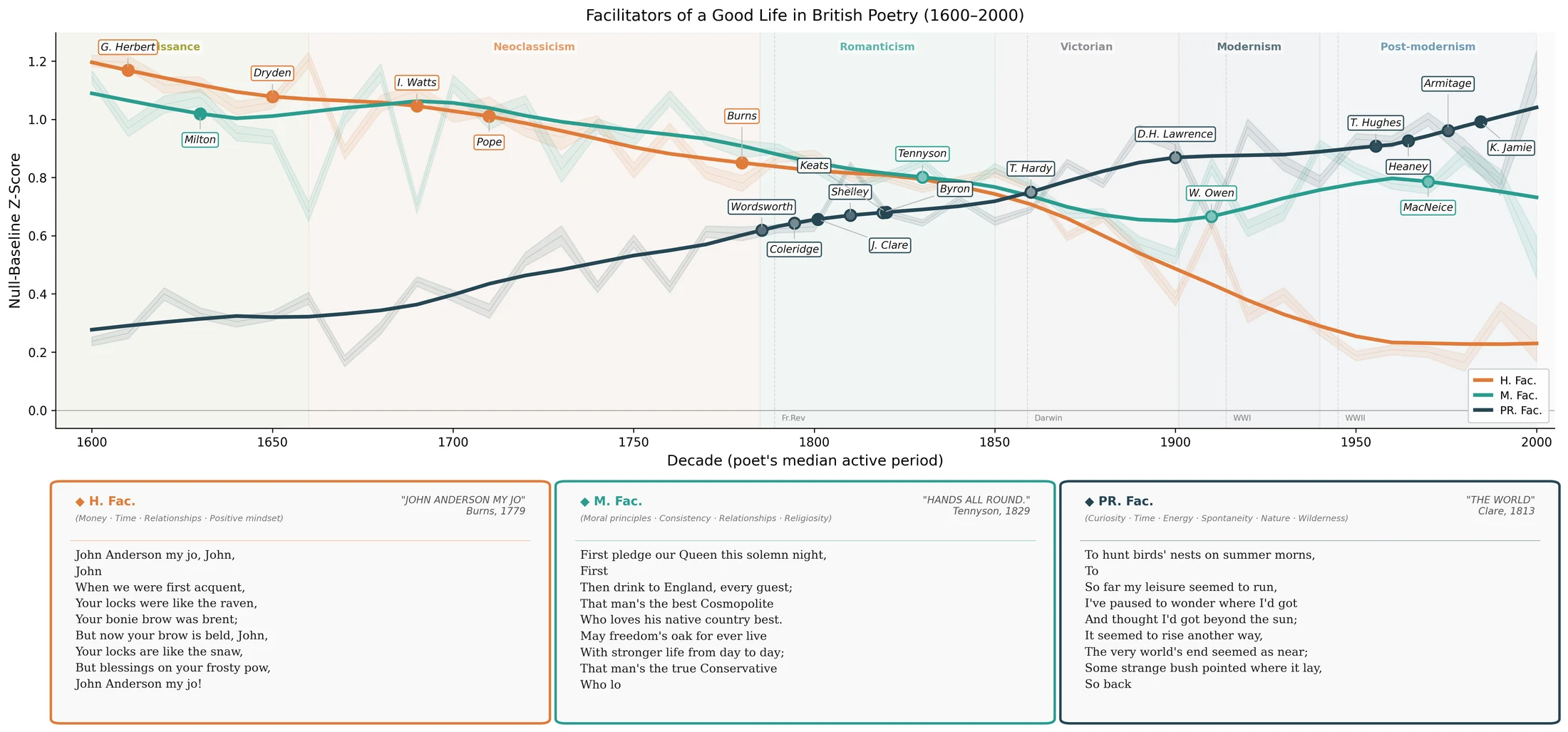
In my poetry project, I use language models to examine ideals of a good life expressed in British poetry (1600–2000) and pre-modern Chinese poetry. This extends the question beyond present-day surveys: how does the place of learning, adventure, and changing perspectives in an imagined good life vary across periods and cultures? The analysis concerns what poems express, not a direct measure of how people lived.
Related published work
Our cognitive complexity study (JRP) connects richness with how people understand others: those who saw their lives as richer reported considering multiple influences on other people’s behavior.
In broader work on well-being, our meta-analysis of gratitude interventions (PNAS) found a small average improvement in well-being across studies from 28 countries, with effects that varied between countries.
Work & curiosity
When does “not my job” become “not worth knowing”?
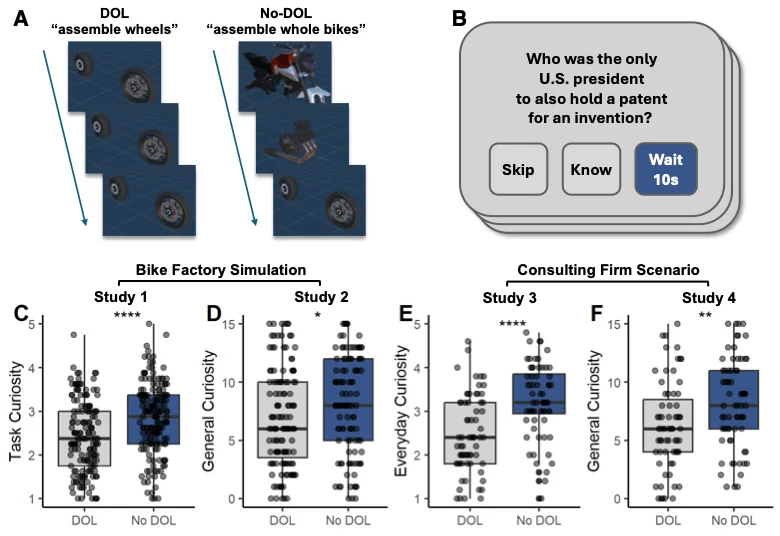
Dividing work helps us become efficient. My experiments ask what happens to curiosity when people take on a narrow role—even their curiosity about things outside the task.
Work & curiosity
When does “not my job” become “not worth knowing”?
Dividing work helps us become efficient. My experiments ask what happens to curiosity when people take on a narrow role—even their curiosity about things outside the task.
Specialization separates what people are responsible for from what falls outside their role. My question is whether “not my job” can become “not worth knowing.” Across five survey datasets covering more than 475,000 workers, more finely divided work was associated with less learning, curiosity, and novelty seeking. Four preregistered randomized experiments tested this link: people who experienced or imagined specialized work were less curious, including about unrelated trivia. In the assembly experiments, enjoyment and fulfillment did not significantly decline.
In related projects, I examine whether these boundaries extend beyond work. Experiments on concern for climate change and exploratory analyses of workers’ language on Reddit test how specialization relates to engagement with social problems and other people. A Thaler-Tversky grant supports further tests in real work groups.
Inequality & aspirations
Why do so many children dream of the same jobs?
Exploring also means imagining who we might become. I study why young people’s ambitions crowd into a few popular occupations, and how inequality may narrow the futures they consider.
Inequality & aspirations
Why do so many children dream of the same jobs?
Exploring also means imagining who we might become. I study why young people’s ambitions crowd into a few popular occupations, and how inequality may narrow the futures they consider.
Exploring also means considering who we might become. Why do young people’s dreams crowd into the same few occupations? Across 1.66 million adolescent responses from 90 countries and economies, 43.1% named one of the ten jobs most commonly expected in their country and survey year. Students were asked what job they expected to hold around age 30. I call this concentration occupational herding. It was greater in more unequal societies, even after accounting for labor-market diversity and students’ socioeconomic backgrounds.
In a preregistered experiment, adults shown a projection of higher future inequality expressed stronger preferences for a future child to follow popular career paths over the child’s own interests. Together, these findings suggest that inequality may narrow the futures young people consider.
Like my work on the division of labor, this project asks whether social conditions shape more than people’s opportunities: they may also shape which possibilities people consider worth pursuing.
Related published work
Cities & new experiences
Can a city make room for curiosity?
A bookstore, a museum, a place you did not plan to visit. I study where people find new perspectives—and whether having those places close together makes a difference.
Cities & new experiences
Can a city make room for curiosity?
A bookstore, a museum, a place you did not plan to visit. I study where people find new perspectives—and whether having those places close together makes a difference.
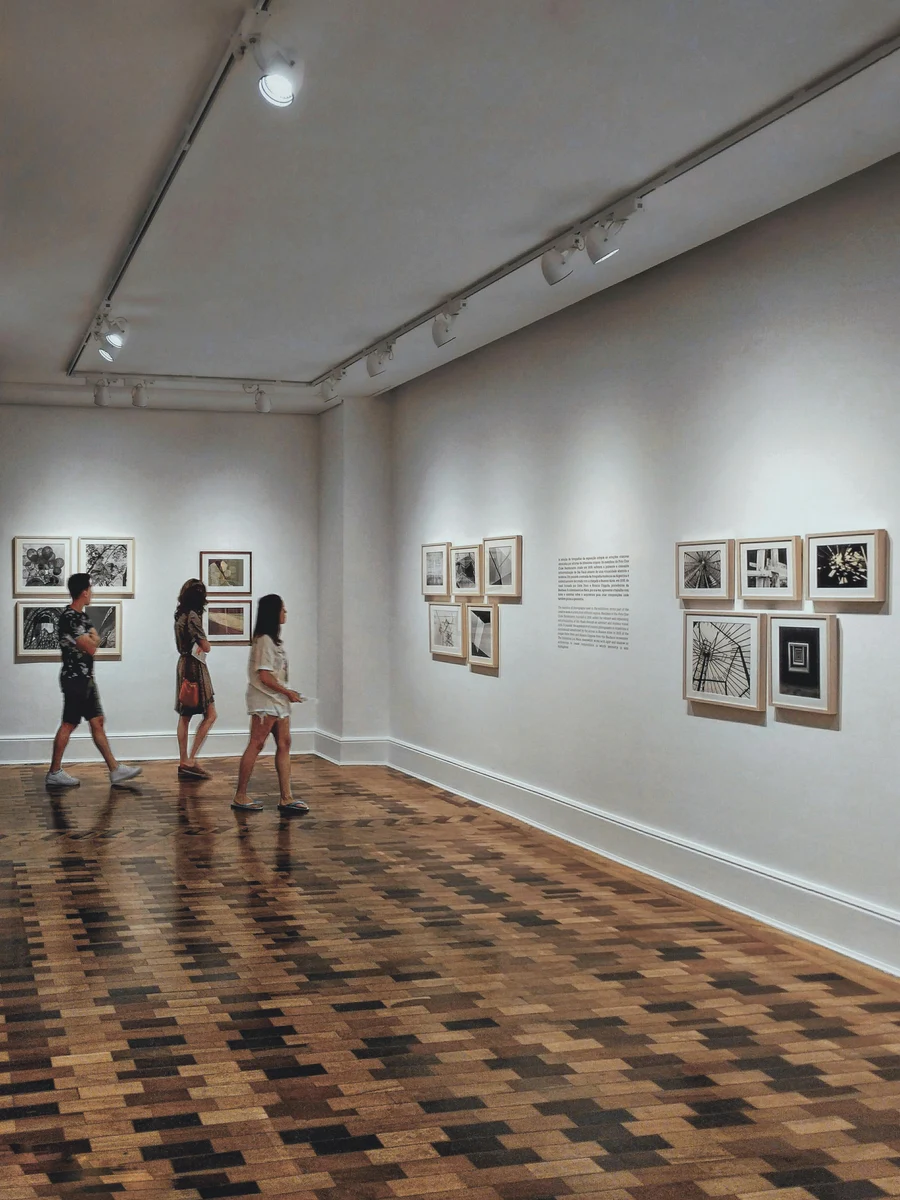
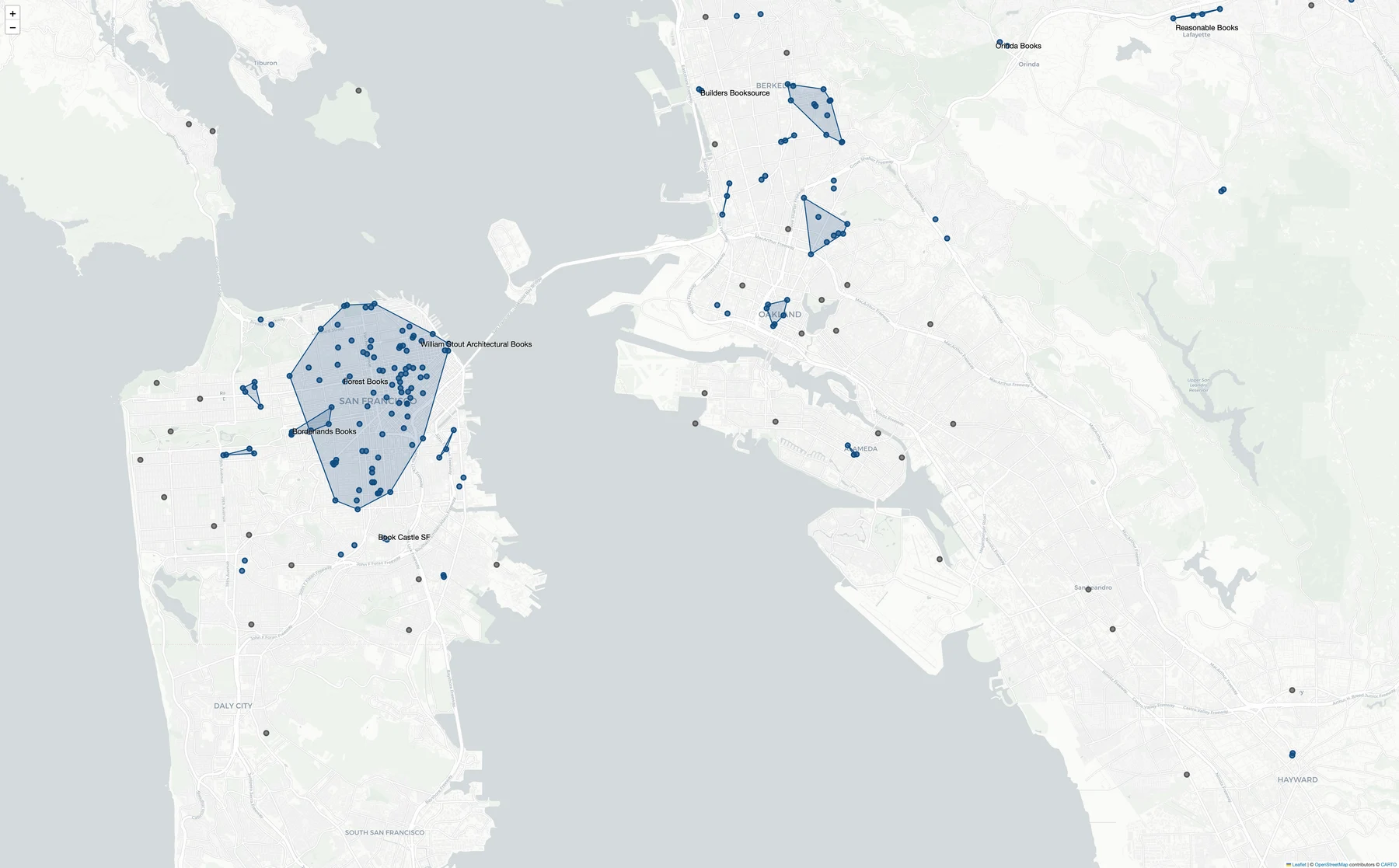
Using natural-language analysis of Google reviews across U.S. cities, I identified places described as offering new knowledge and encouraging curiosity. Across cities, greater clustering of these places—not simply their number—was associated with more patents, greater civic knowledge, and lower implicit bias. This work asks how urban environments create opportunities for unplanned encounters and new experiences.
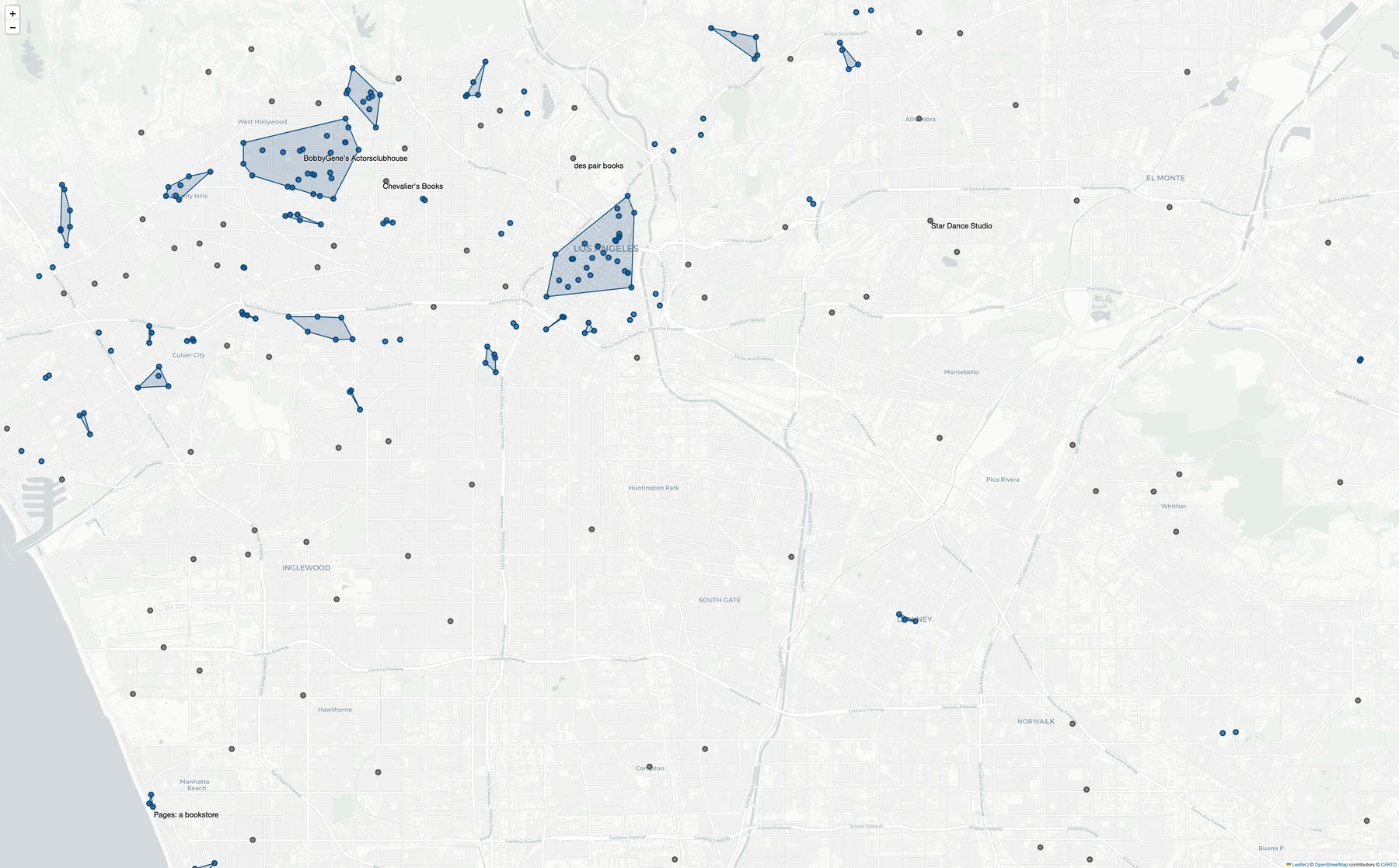
I ask whether clustering makes it easier for one encounter to lead to another. These maps illustrate spatial patterns, not causal effects on residents. Map data © OpenStreetMap contributors; basemap © CARTO.
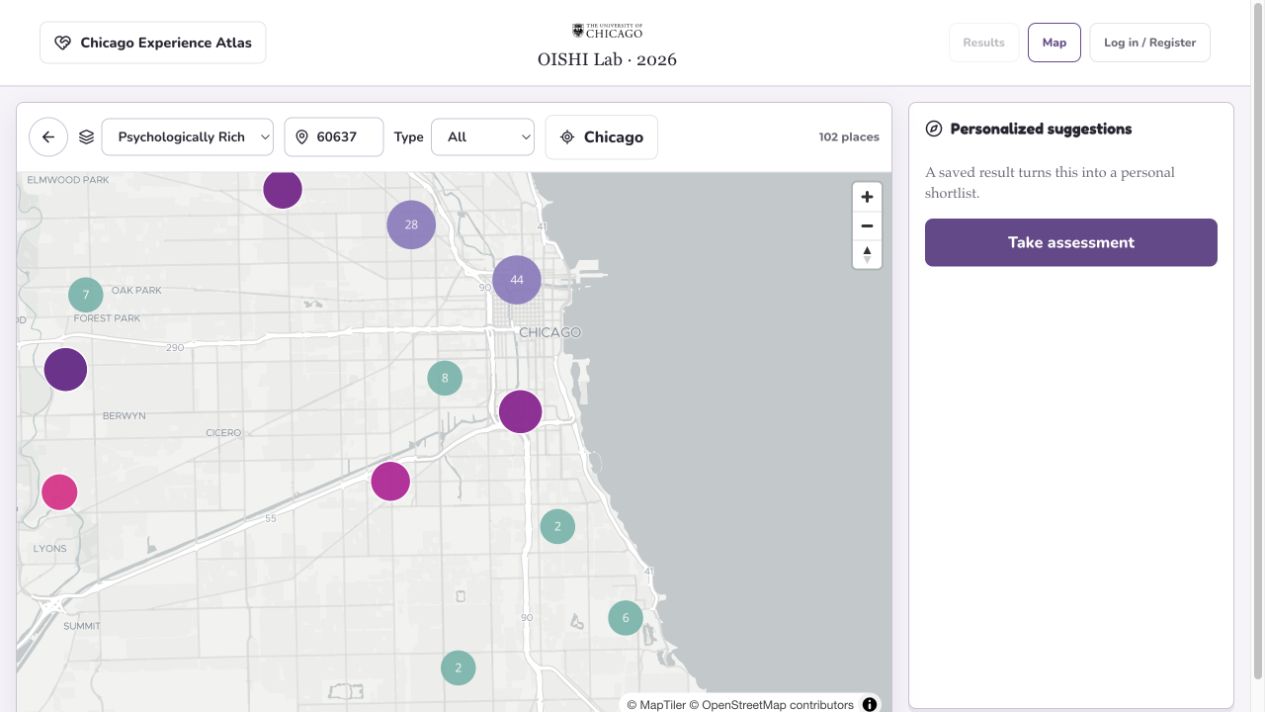
Building on this research, I am developing the Good Life Atlas, an interactive map where people discover neighborhood places and record where they go, what they experience, and how they feel. These reports will let me study person–environment fit: which places support well-being for whom. Participation itself generates data, with the potential to support field experiments across cities.
In a separate project, When the City Feels Like Ours, I ask how inviting surroundings relate to felt ownership and care for shared spaces. Surveys examine these associations, and an agent-based simulation explores how repeated visits might connect them.

AI & conversation
Can a conversation make us curious again?
What would an AI conversation look like if it put psychological richness first? We steer a model’s internal representations to test whether a conversation can renew interest in a topic someone has dismissed.
AI & conversation
Can a conversation make us curious again?
What would an AI conversation look like if it put psychological richness first? We steer a model’s internal representations to test whether a conversation can renew interest in a topic someone has dismissed.
Within one large language model, we found that happiness, meaning, and psychological richness corresponded to nearly orthogonal directions—almost at right angles—in its internal representations. We then adjusted the model along each direction, a technique called steering. In a collaborator-choice task, richness steering increased the model’s exploration, happiness steering reduced it, and meaning steering had no effect.
In a preregistered human experiment, participants who conversed with a richness-steered model rated the conversation as more perspective-broadening and reported greater interest in a previously dismissed social issue than those who conversed with a baseline model. This approach provides a way to manipulate model representations of psychological concepts—and to test what conversations built around them can do.
Discussion and changing perspectives
With a grant from the University of Chicago’s Forum for Free Inquiry and Expression, I test whether discussion across opposing views leads people to value a life of learning and changing perspectives. I will combine the Atlas with steered conversation to test the separate and joint effects of changing opportunities to explore and prompting people to reconsider its value.
Third places · Space & exploration
Chicago Experience Atlas
The Chicago prototype of the Good Life Atlas. Reflect on your well-being, then explore places beyond home and work through happiness, meaning, and psychological richness.
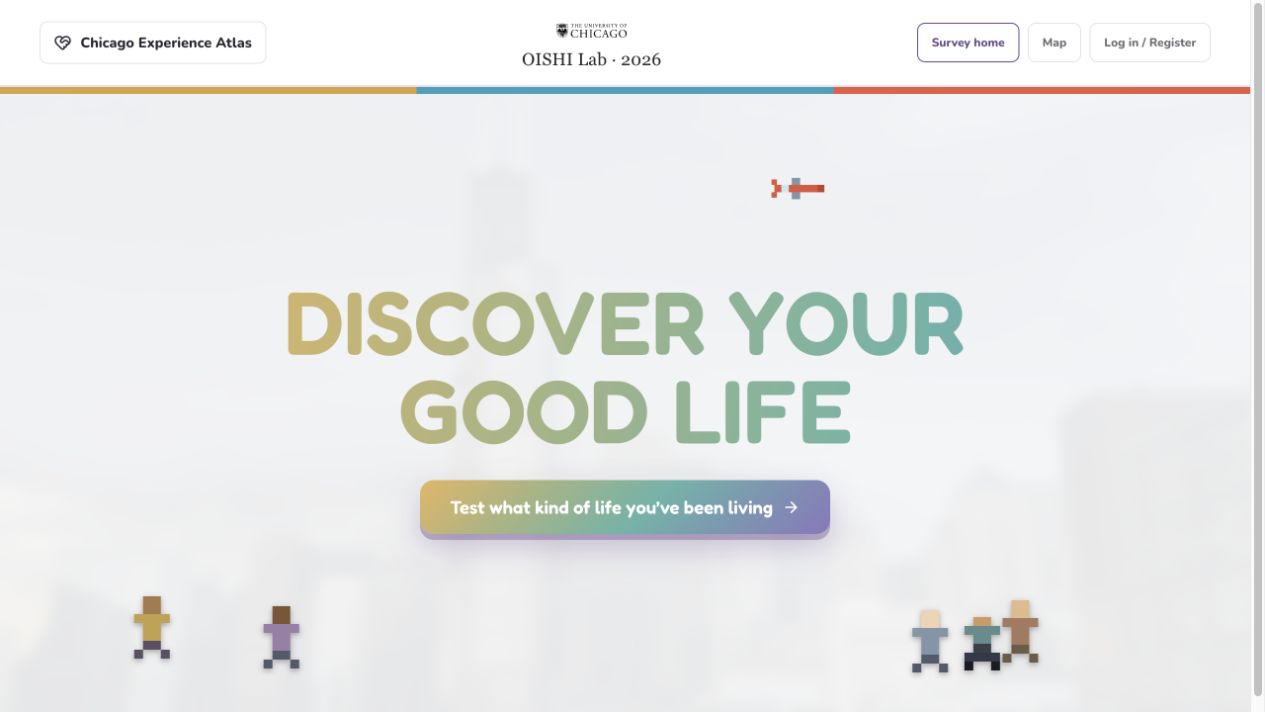
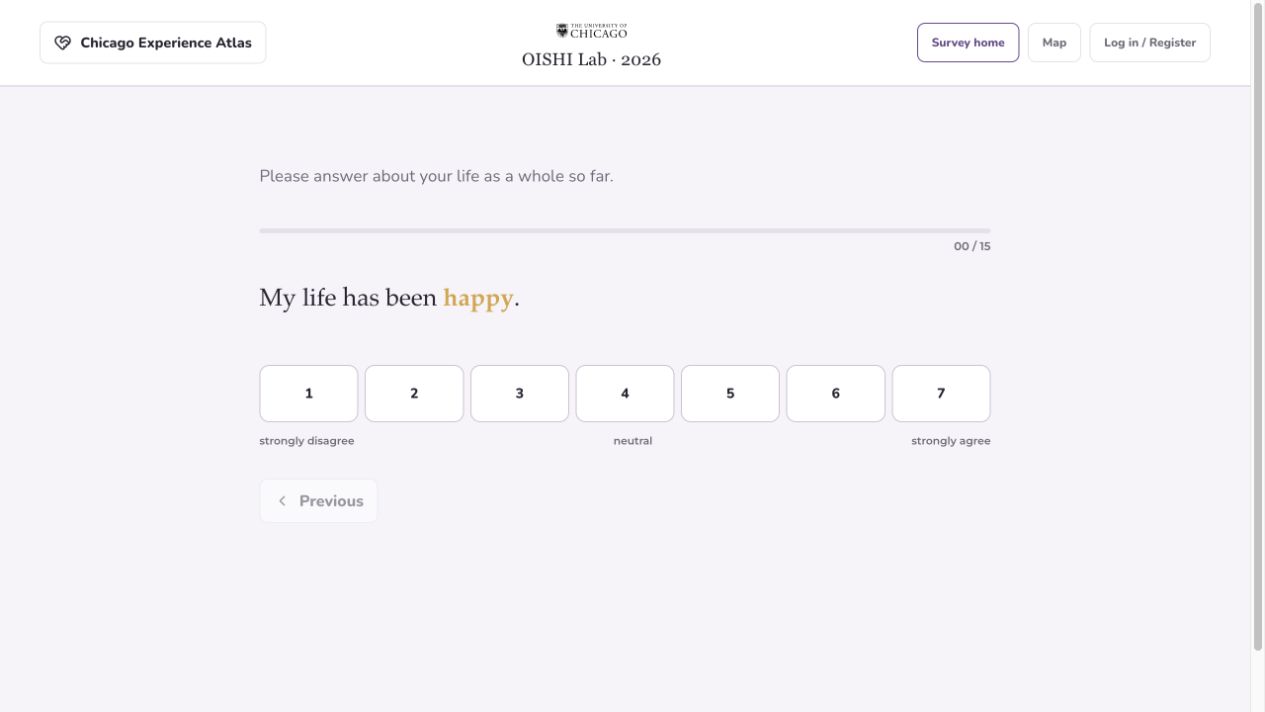
DiscoverAssess your well-beingExplore places
Conversation · AI & exploration
Exploration through conversation
What might a conversation with an AI steered toward psychological richness feel like? Could it invite you to consider a different perspective—or take a fresh interest in a topic you once dismissed?
This demo builds on our research into steering language models through their internal representations of happiness, meaning, and psychological richness.
The research behind the conversation
Psychology’s New Lever: Steering the Good Life Inside Large Language Models
Manuscript in preparation · Abstract submitted to SPSP 2027; decision pending.
We identified nearly orthogonal directions corresponding to happiness, meaning, and psychological richness within one language model and experimentally steered those directions. In a collaborator-choice task, richness steering increased exploration, happiness steering decreased it, and meaning steering had no effect.
In a preregistered study, participants who talked with a richness-steered model rated the conversation as more perspective-broadening and reported greater interest in an initially dismissed social issue than those who talked with a baseline model. Happiness steering showed no comparable pattern.